Why Preventive Maintenance is Critical for Industrial Reliability
In today’s competitive manufacturing landscape, unplanned downtime isn’t just an inconvenience it’s a profit killer. Discover how a structured preventive maintenance strategy transforms plant performance and keeps your operations running at peak capacity.
What Is Preventive Maintenance and Why Does It Matter?
Preventive maintenance (PM) is a proactive approach to equipment care scheduling inspections, servicing, and repairs at regular intervals before a failure ever occurs. Unlike reactive “fix-it-when-it-breaks” strategies, preventive maintenance is designed to keep assets in optimal working condition throughout their full service life.
For industrial operations, this distinction is everything. A single hour of unplanned downtime in a high-throughput facility can cost tens of thousands of dollars in lost production, labor waste, and emergency repair fees. According to industry research, unplanned downtime costs industrial manufacturers an estimated $50 billion annually. The good news? The majority of those losses are preventable.
The Direct Link Between Preventive Maintenance and Industrial Reliability
Industrial reliability is the probability that equipment performs its intended function without failure over a defined period. It is the backbone of consistent production output, quality control, and customer satisfaction and preventive maintenance is its strongest enabler.
When machines are regularly inspected and serviced, wear-and-tear is caught early. Bearings get replaced before they seize. Lubrication is applied before friction causes overheating. Electrical connections are tightened before they arc. Each of these small interventions prevents a cascading failure that could take an entire production line offline for days.
The result is a measurable improvement in three key reliability metrics:
- Mean Time Between Failures (MTBF) — extends significantly with consistent PM schedules
- Overall Equipment Effectiveness (OEE) — rises as availability and performance losses are reduced
- Asset lifespan — prolonged through proper care, delaying costly capital replacement
How Preventive Maintenance Powers Automation Maintenance Programs
Modern industrial facilities are increasingly dependent on automation systems PLCs, servo drives, robotic cells, conveyor systems, and sensor networks. These technologies offer extraordinary precision and throughput, but they also introduce new maintenance complexity.
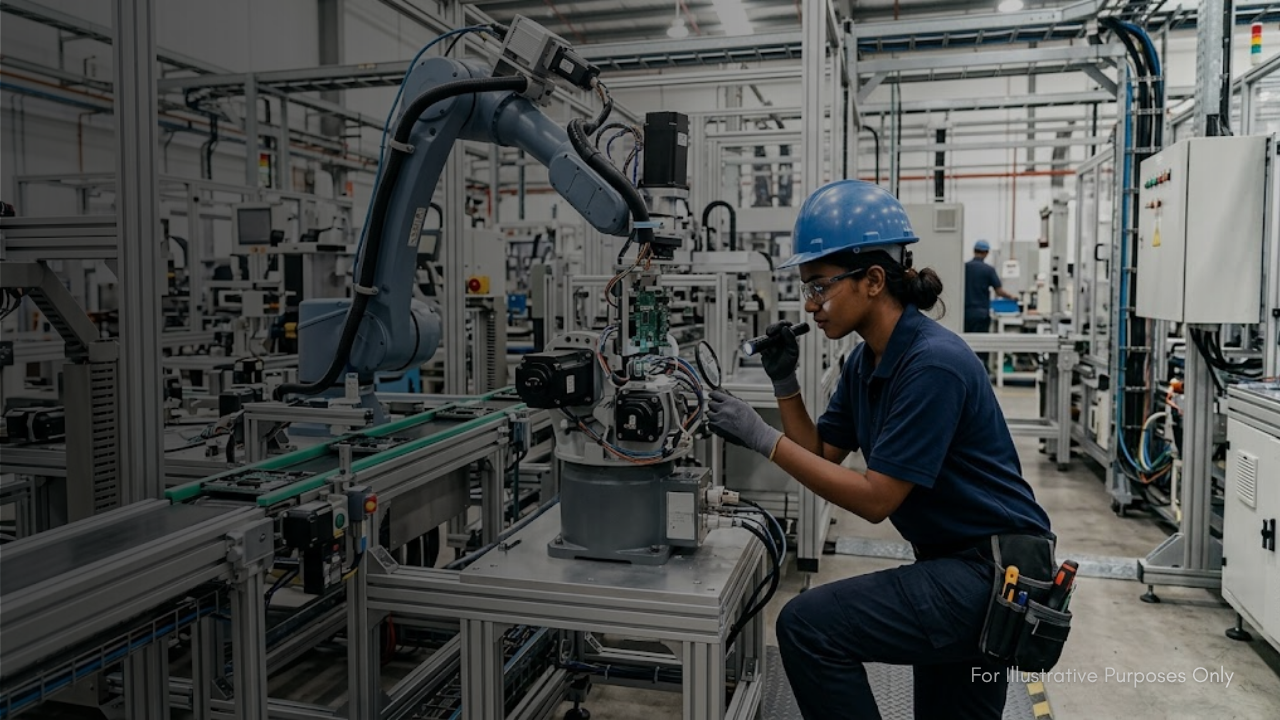
Automation maintenance is not optional. Automated systems operate at high speeds and loads, and their failure modes are often sudden and severe. A faulty encoder on a robotic arm or a degraded drive on a conveyor doesn’t give much warning but a structured PM program will catch the early indicators through vibration analysis, thermal imaging, and cycle-count tracking.
Effective automation maintenance within a PM framework typically includes:
- Scheduled calibration cycles for sensors and control systems
- Firmware and software update reviews to maintain cybersecurity and performance standards
- Mechanical inspections of actuators, grippers, and drive components
- Electrical checks on wiring harnesses, terminal blocks, and safety circuits
- Lubrication and filter replacement on pneumatic and hydraulic subsystems
Integrating these checks into a digital Computerized Maintenance Management System (CMMS) allows maintenance teams to track asset history, schedule work orders automatically, and generate compliance reports turning reactive chaos into structured, data-driven operations.
The Impact on Plant Performance
Sustained plant performance is not accidental, it is engineered through disciplined operational practices, and preventive maintenance sits at the heart of that effort.
Facilities with mature PM programs consistently report:
- 20–25% reduction in maintenance costs compared to reactive-only strategies
- Up to 30% improvement in equipment uptime and availability
- Significant gains in product quality, as well-maintained equipment operates within tighter tolerances
- Enhanced workforce safety, since equipment failures are a leading cause of industrial accidents
Beyond the numbers, a high-performing PM program builds a culture of ownership among maintenance technicians. When teams move from firefighting to planning, morale improves, institutional knowledge grows, and continuous improvement becomes possible.
Building Your Preventive Maintenance Strategy: Where to Start
Transitioning to a preventive maintenance model doesn’t happen overnight, but the steps are straightforward:
- Audit your current asset inventory — identify every piece of critical equipment and its current condition
- Prioritize by criticality — focus PM efforts first on assets whose failure would have the greatest operational or safety impact
- Establish maintenance intervals — use OEM recommendations, historical failure data, and condition monitoring to set realistic schedules
- Implement a CMMS — digitize your work orders, PM schedules, and spare parts inventory for full visibility
- Train your team — ensure technicians understand not just what to check, but why each task matters
- Review and refine — treat your PM program as a living system, updating intervals based on real-world performance data
Conclusion: Reliability Is Built, Not Hoped For
Industrial reliability doesn’t happen by chance. It is the direct result of deliberate, consistent investment in preventive maintenance, an investment that pays dividends in uptime, plant performance, equipment longevity, and team confidence.
Whether you are managing a single production line or a multi-site manufacturing operation, the principle is the same: maintain proactively, or pay reactively. The cost of prevention is always a fraction of the cost of failure.
Now is the time to assess your automation maintenance practices, strengthen your PM program, and build the foundation for world-class industrial reliability.
Want to learn more about optimising your maintenance strategy? Subscribe to our newsletter for weekly insights on industrial operations, automation, and reliability engineering.

We serve the marine transportation, oil & gas, power generation, oleochemicals and petrochemical industries.
Join Our Newsletter
Stay updated with the latest in our field! Subscribe to our newsletter and visit our website for more information.