Maximizing Uptime with Predictive Maintenance & Condition Monitoring
In today’s highly competitive industrial landscape, unexpected equipment failures can lead to costly downtime, production losses, safety risks, and expensive emergency repairs. Industries such as oil & gas, marine transportation, manufacturing, petrochemical, and power generation depend heavily on reliable equipment performance to maintain operational efficiency.
This is where predictive maintenance and advanced condition monitoring become essential. By leveraging Industrial IoT technologies, manufacturing analytics, and advanced instrumentation and control systems, companies can move beyond traditional maintenance approaches and build smarter, more resilient operations.
For organizations seeking long-term operational stability, partnering with an experienced system integrator can significantly improve asset reliability while reducing maintenance costs.
Understanding Reactive vs Predictive Maintenance
Many industrial facilities still rely heavily on reactive maintenance, commonly known as “run-to-failure” maintenance. In this approach, maintenance is only performed after equipment breaks down. While this may appear cost-effective initially, it often results in:
- Unexpected production downtime
- High repair costs
- Emergency spare part purchases
- Reduced equipment lifespan
- Increased safety hazards
- Lower operational efficiency
For example, a failed motor in a production line can halt operations for hours or even days, affecting delivery schedules and customer commitments.
Predictive maintenance, on the other hand, uses real-time equipment data and condition monitoring technologies to identify early signs of equipment deterioration before failure occurs. Instead of waiting for breakdowns, maintenance teams can proactively schedule repairs during planned shutdowns.
This shift from reactive to predictive maintenance helps organizations:
- Increase equipment uptime
- Improve operational safety
- Extend asset lifespan
- Reduce maintenance expenses
- Optimize workforce planning
- Improve production reliability
What is Condition Monitoring?
Condition monitoring refers to the continuous or periodic monitoring of equipment health using specialized sensors and analytics tools. These systems detect abnormal operating conditions that may indicate developing faults.
Modern condition monitoring solutions are powered by Industrial IoT platforms that collect and analyze data from machinery in real time. This enables engineers and plant operators to make informed maintenance decisions based on actual equipment conditions rather than fixed maintenance intervals.
Common parameters monitored include:
- Vibration levels
- Temperature
- Pressure
- Motor current
- Lubrication condition
- Cable insulation integrity
- Rotational speed
- Acoustic emissions
By integrating manufacturing analytics with instrumentation and control systems, facilities gain deeper visibility into equipment performance and operational trends.
The Role of Vibration Monitoring
One of the most effective predictive maintenance tools is vibration monitoring.
Rotating equipment such as pumps, compressors, turbines, motors, and fans naturally produce vibration during operation. However, abnormal vibration patterns often indicate mechanical issues such as:
- Bearing wear
- Shaft misalignment
- Imbalance
- Mechanical looseness
- Gear defects
- Cavitation
Without early detection, these problems can escalate into catastrophic failures that damage critical equipment and disrupt operations.
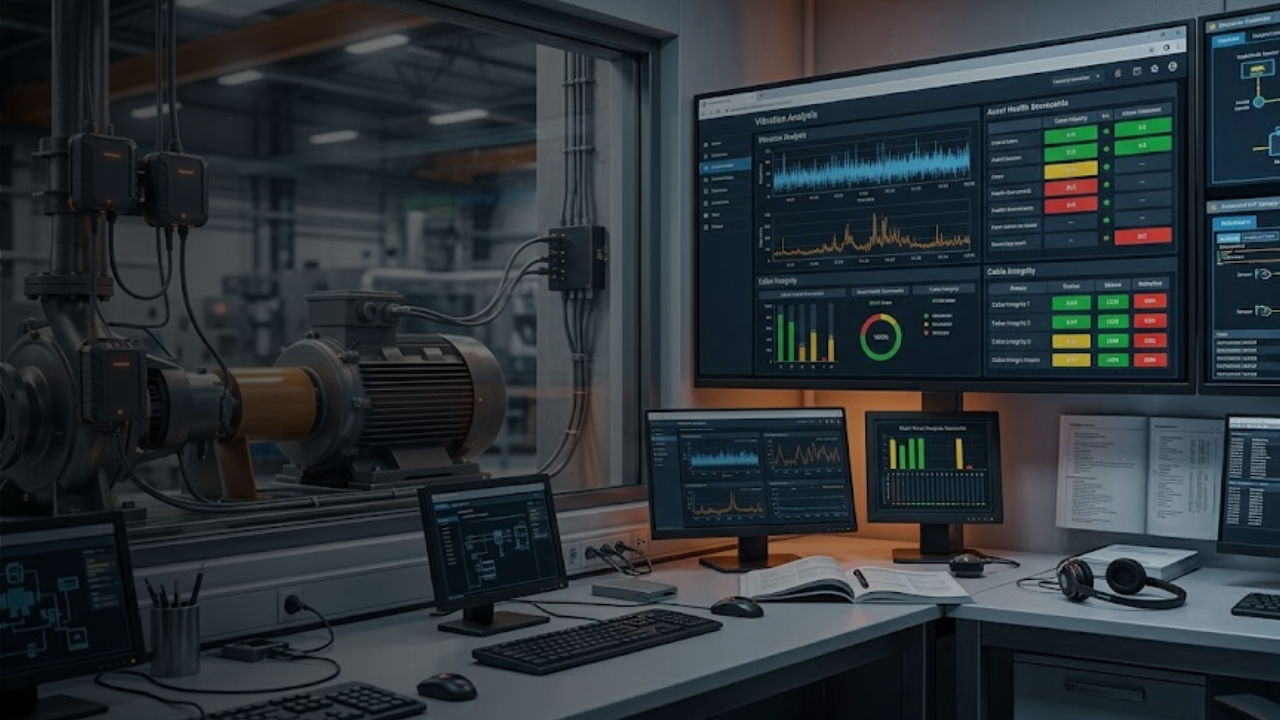
Advanced vibration monitoring systems continuously track machine conditions and provide alerts when abnormal trends are detected. Maintenance teams can then investigate and resolve issues before serious damage occurs.
Benefits of vibration monitoring include:
- Reduced unplanned downtime
- Lower repair costs
- Improved machine reliability
- Increased equipment lifespan
- Better maintenance scheduling
For industries operating critical assets around the clock, vibration analysis is an essential part of a modern predictive maintenance strategy.
Cable Health Monitoring for Critical Infrastructure
In many industrial facilities, cable failures are often overlooked until major operational problems occur. Damaged or deteriorating cables can lead to:
- Power interruptions
- Signal instability
- Equipment malfunction
- Fire hazards
- Costly shutdowns
Cable health monitoring systems help identify insulation degradation, moisture intrusion, overheating, and other electrical issues before failures happen.
Using advanced monitoring technologies and manufacturing analytics, engineers can continuously assess cable conditions across industrial plants, offshore platforms, marine vessels, and power systems.
This proactive approach allows organizations to:
- Prevent unexpected electrical failures
- Improve operational safety
- Reduce replacement costs
- Enhance infrastructure reliability
- Extend cable service life
For industries with mission-critical operations, cable health monitoring plays a key role in maintaining continuous uptime and minimizing operational risks.
Industrial IoT and Smart Maintenance Strategies
The rise of Industrial IoT has transformed how industries manage maintenance and asset performance.
Smart sensors, cloud-based analytics, and connected control systems now provide real-time operational insights across entire facilities. Instead of relying solely on manual inspections, maintenance teams can access live data dashboards, automated alerts, and predictive analytics tools.
By integrating Industrial IoT technologies with instrumentation and control systems, organizations can:
- Detect faults earlier
- Monitor multiple assets remotely
- Improve maintenance planning
- Reduce human error
- Increase operational transparency
- Support data-driven decision making
These technologies are especially valuable in complex industrial environments where downtime can result in substantial financial losses.
Why Partner with an Experienced System Integrator?
Implementing predictive maintenance solutions requires more than just installing sensors. Success depends on proper system integration, data interpretation, automation expertise, and long-term technical support.
An experienced system integrator can help organizations design and implement customized condition monitoring solutions that align with operational goals and industry requirements.
A reliable integration partner provides expertise in:
- Instrumentation and control systems
- Industrial automation
- SCADA and monitoring platforms
- Industrial IoT integration
- Vibration analysis systems
- Cable health monitoring technologies
- Manufacturing analytics solutions
With decades of industry experience, the right partner can help businesses reduce risks, improve uptime, and maximize asset longevity.
Building a More Reliable Future
As industries continue to modernize, predictive maintenance and condition monitoring are becoming essential components of operational excellence. Companies that embrace these technologies gain a significant advantage through improved reliability, reduced downtime, and smarter maintenance planning.
By leveraging Industrial IoT, advanced manufacturing analytics, and expert instrumentation and control integration, organizations can shift from reactive problem-solving to proactive asset management.
The result is a safer, more efficient, and more resilient operation capable of meeting the demands of modern industry while protecting long-term investments.

We serve the marine transportation, oil & gas, power generation, oleochemicals and petrochemical industries.
Join Our Newsletter
Stay updated with the latest in our field! Subscribe to our newsletter and visit our website for more information.