Essential Technical Skills Every Automation Engineer Should Master
The demand for skilled automation engineers has never been higher. As industries worldwide accelerate their shift toward smart manufacturing and Industry 4.0, companies are actively hunting for professionals who can design, implement, and maintain complex automated systems. But breaking into or advancing in this field requires a very specific set of technical skills.
Whether you’re just starting your automation engineering career or looking to level up, this guide covers the core competencies you need to master to stay competitive and relevant.
1. PLC Programming: The Backbone of Industrial Automation
If there is one skill that defines an automation engineer, its PLC (Programmable Logic Controller) programming. PLCs are the brains behind virtually every industrial process from assembly lines to water treatment plants.
Mastering PLC programming means becoming proficient in the five IEC 61131-3 standard languages:
- Ladder Diagram (LD) — the most widely used, designed to resemble relay logic circuits
- Structured Text (ST) — a high-level, Pascal-like language ideal for complex algorithms
- Function Block Diagram (FBD) — graphical and intuitive for process control
- Sequential Function Chart (SFC) — perfect for sequencing operations
- Instruction List (IL) — low-level and useful for performance-critical tasks
Beyond syntax, strong PLC programming skills include understanding I/O mapping, fault diagnostics, and writing clean, maintainable code that your colleagues can follow. Familiarity with leading platforms Siemens TIA Portal, Rockwell Studio 5000, and Mitsubishi GX Works is a significant career advantage.
Pro tip: Get hands-on with simulator software before touching real hardware. PLCSIM and RSLogix Emulate are excellent starting points.
2. SCADA Development: Visualizing and Controlling Processes at Scale
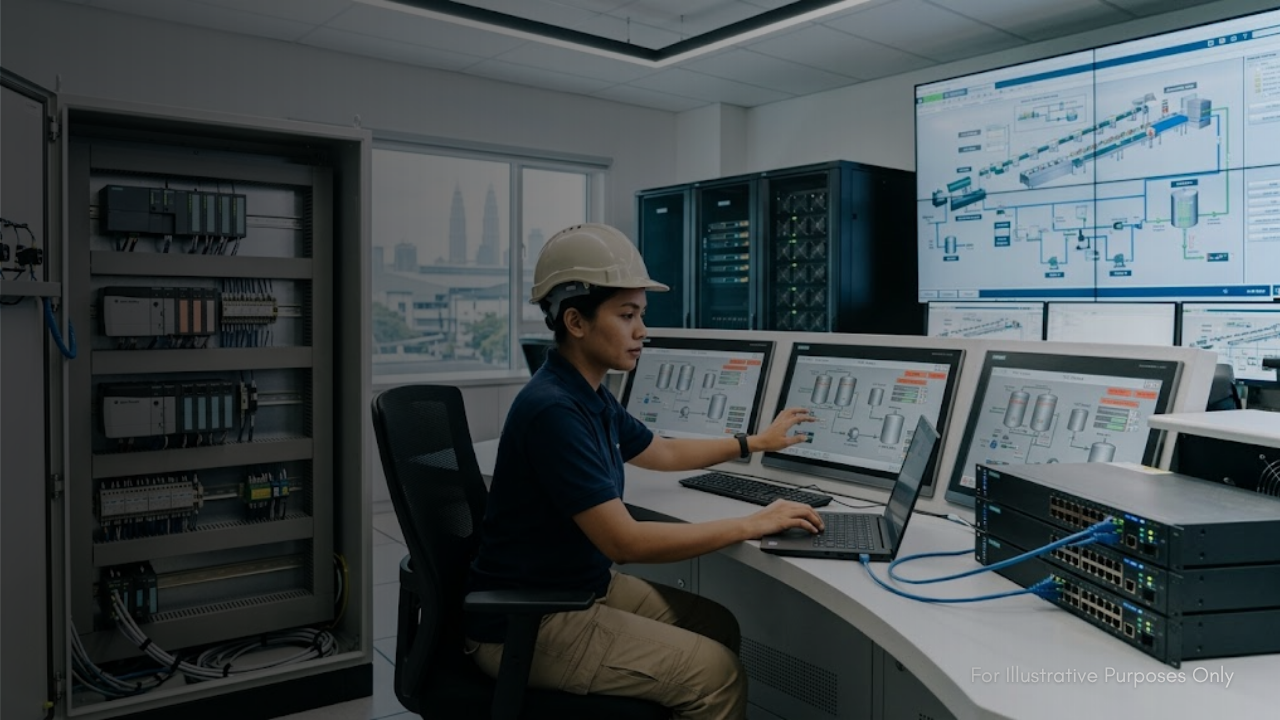
SCADA (Supervisory Control and Data Acquisition) development is the other pillar of automation engineering. While PLCs manage the machinery on the floor, SCADA systems give engineers and operators a real-time window into what’s happening across an entire facility or even across multiple sites globally.
Proficiency in SCADA development means you can:
- Design intuitive Human Machine Interfaces (HMIs) that operators can use under pressure
- Configure reliable data acquisition pipelines from field devices
- Set up alarming and historian systems to track trends and flag anomalies
- Build secure communication links using protocols like OPC-UA, Modbus, and DNP3
Leading platforms to learn include Ignition by Inductive Automation, Wonderware (AVEVA), and Siemens WinCC. As SCADA systems increasingly move to the cloud, engineers who understand both on-premise and cloud-hosted SCADA architectures are becoming exceptionally valuable.
3. Networking and Industrial Communication Protocols
Modern automation systems don’t operate in isolation, they communicate constantly. A solid understanding of industrial networking is non-negotiable for today’s automation engineer.
You should be comfortable working with:
- EtherNet/IP, PROFINET, and DeviceNet for device-level communication
- MQTT and OPC-UA for IoT and cloud connectivity
- TCP/IP fundamentals for network troubleshooting and configuration
- Cybersecurity basics industrial environments are increasingly targeted by cyber threats, and engineers who can design secure architectures are worth their weight in gold
4. Robotics and Motion Control
Automation engineering and robotics go hand in hand. Whether you’re working with collaborative robots (cobots) in an assembly cell or coordinating multi-axis CNC systems, understanding motion control is a key differentiator.
Skills to develop include:
- Programming industrial robots (FANUC, KUKA, ABB, Universal Robots)
- Understanding servo systems, drives, and encoders
- Designing safety systems compliant with ISO 10218 and ISO/TS 15066
- Basics of kinematics how robots move through space
5. Programming and Scripting Beyond PLC Ladders
Automation engineers who can code beyond ladder logic open significantly more doors. Python in particular has become a staple skill, it’s used for data analysis, test automation, interfacing with APIs, and building custom tools.
Other languages worth learning:
- C/C++ for embedded systems and low-level device programming
- SQL for querying historian and MES databases
- JavaScript or Node.js for building lightweight web dashboards
If you work in pharmaceutical, food & beverage, or regulated industries, understanding ISA-88 batch standards and how to implement them in code is also a strong career asset.
6. Instrumentation and Process Control Theory
Great automation engineers understand not just how to wire up a sensor, but why a control strategy is designed a certain way. A strong foundation in instrumentation and process control includes:
- PID tuning knowing when and how to adjust proportional, integral, and derivative parameters
- Reading and creating P&IDs (Piping and Instrumentation Diagrams)
- Understanding transmitter types pressure, temperature, flow, and level
- Basics of loop calibration and troubleshooting
Building Your Automation Engineering Career
Technical skills alone won’t carry your career. You also need the soft skills to collaborate with cross-functional teams, communicate complex ideas to non-technical stakeholders, and document your work clearly. But getting your technical foundation right first is what separates average engineers from exceptional ones.
Start with PLC programming and SCADA development as your core. Build outward into networking, robotics, and software. Stay curious, pursue certifications (ISA’s CCST and CAP are industry-recognized benchmarks), and never stop building things.
The automation industry is growing fast. The engineers who commit to continuous learning are the ones who will lead it.

We serve the marine transportation, oil & gas, power generation, oleochemicals and petrochemical industries.
Join Our Newsletter
Stay updated with the latest in our field! Subscribe to our newsletter and visit our website for more information.