The Future of Smart Manufacturing: Trends Shaping Industry 4.0
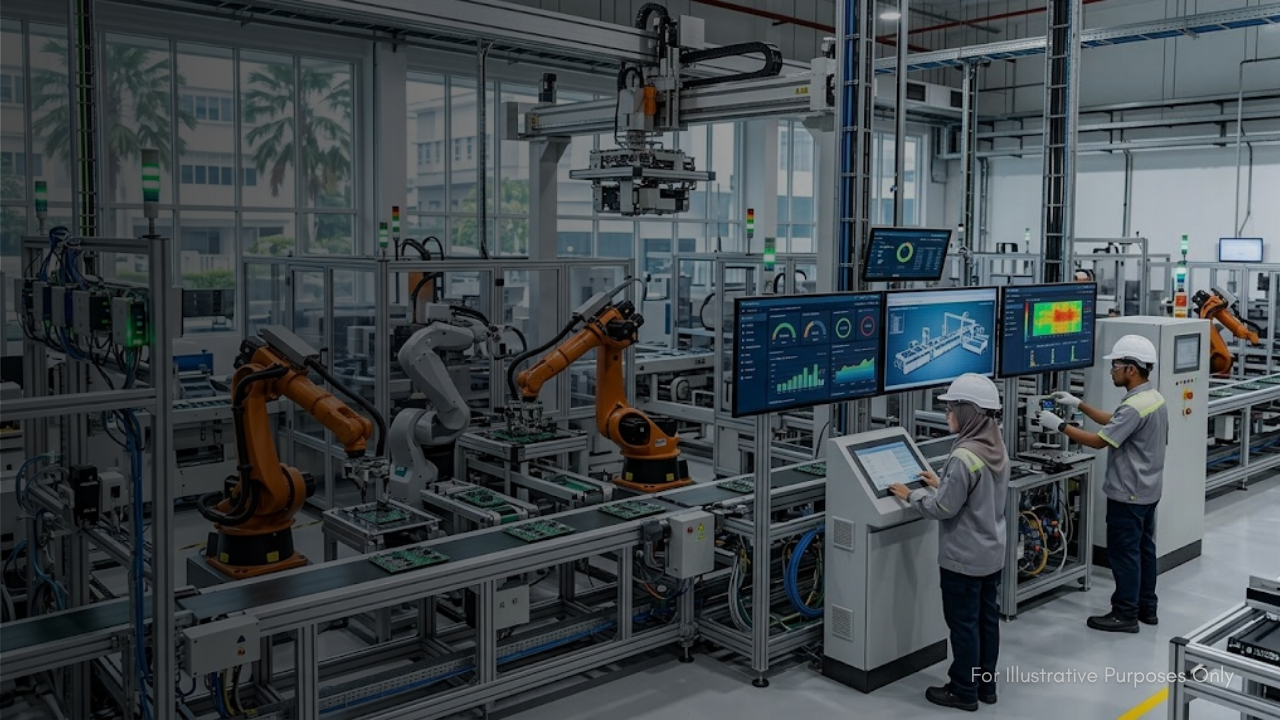
Manufacturing is undergoing its most profound transformation in over a century. The fourth industrial revolution widely known as Industry 4.0 is merging the physical and digital worlds through cyber-physical systems, the Industrial Internet of Things (IIoT), cloud computing, and artificial intelligence. The result is a new breed of factory: adaptive, data-driven, and extraordinarily efficient.
For decision-makers and engineers alike, understanding the forces driving this shift isn’t optional, it’s a strategic imperative. Below, we break down the defining trends in smart manufacturing today and what they mean for the industry’s next decade.
What is Industry 4.0, really?
The term Industry 4.0 was first coined at the Hannover Messe trade fair in 2011 as a German government initiative to describe the next wave of industrial automation. Today, it describes an integrated ecosystem where machines communicate autonomously, data flows in real time, and production systems adapt dynamically to changing conditions with minimal human intervention.
At its core, digital transformation in manufacturing is about connecting previously siloed assets: machines, people, processes, and supply chains into a single, intelligent network. This isn’t simply automation, it’s the convergence of operational technology (OT) and information technology (IT) at every layer of the factory.
"The factory of the future will be self-optimizing, self-configuring, and capable of producing highly customized products at scale without sacrificing efficiency."
Six trends reshaping smart manufacturing
1. Industrial IoT: the connected factory The Industrial Internet of Things is the backbone of smart manufacturing. Sensors embedded in machines, conveyor systems, and equipment continuously stream performance data, enabling real-time condition monitoring and predictive maintenance. IIoT connectivity allows manufacturers to detect anomalies before they become failures, reducing unplanned downtime by up to 50% in mature deployments.
2. Artificial intelligence and machine learning AI is moving from pilot projects to production lines. In quality control, computer vision models inspect products at line speed with far greater accuracy than human inspectors. In planning, machine learning algorithms optimize production scheduling, demand forecasting, and inventory management dynamically rebalancing resources when demand or supply signals shift.
3. Digital twins A digital twin is a virtual replica of a physical asset or process, continuously updated with real-world data. Manufacturers use digital twins to simulate process changes, stress-test new product configurations, and predict the outcome of engineering decisions all before making changes to the actual production environment. The global digital twin market is forecast to exceed $110 billion by 2028.
4. Edge computing Sending every data point from every sensor to the cloud creates latency and bandwidth costs that don’t work for time-sensitive manufacturing processes. Edge computing solves this by processing data locally at or near the machine so decisions happen in milliseconds. The cloud handles aggregation and long-term analytics; the edge handles real-time response.
5. Collaborative robotics (cobots) Unlike traditional industrial robots that operate in caged-off cells, cobots are designed to work side-by-side with human workers. They handle repetitive, ergonomically demanding, or precision-critical tasks, while workers focus on judgment-intensive work. Falling hardware costs and no-code programming platforms are bringing cobot adoption within reach of small and mid-size manufacturers.
6. Cybersecurity for OT/IT convergence The more connected a factory becomes, the larger its attack surface. As IT and OT networks converge under Industry 4.0, manufacturers face a new class of cybersecurity challenges from ransomware targeting SCADA systems to supply-chain vulnerabilities. Cybersecurity is no longer an IT afterthought; it is a core pillar of any credible digital transformation strategy in manufacturing.
The human side of digital transformation
Technology alone doesn’t transform a factory people do. The organizations succeeding with Industry 4.0 share a common trait: they invest in workforce development alongside technology deployment. Upskilling programs, cross-functional digital teams, and a culture that treats data as a shared asset are as important as any sensor or software platform.
Resistance to change remains the most underestimated barrier to smart manufacturing adoption. Leaders who communicate a clear “why” connecting new technology to business outcomes workers understand see faster, more sustainable results than those who lead with the technology itself.
According to McKinsey, companies that combine technology investment with workforce reskilling are 2.5× more likely to sustain their Industry 4.0 gains over five years compared to those that focus on technology alone.
Getting started: a practical framework
For manufacturers earlier in their Industry 4.0 journey, the scale of the transformation can feel paralyzing. A practical approach focuses on three sequential priorities.
- Connect and capture. Before optimization is possible, visibility is required. Start by connecting existing assets with low-cost IIoT sensors and building a foundational data layer. Even basic dashboards that surface machine uptime and OEE in real time deliver immediate value and build organizational trust in data-driven decisions.
- Analyze and predict. Once data flows reliably, apply analytics to identify patterns and predictive signals. Predictive maintenance is often the highest-ROI early use case, the ability to schedule maintenance based on actual machine condition rather than fixed intervals reduces costs and increases asset availability.
- Automate and optimize. With visibility and analytics in place, automation becomes far less risky and more targeted. Closed-loop systems where AI recommendations automatically trigger process adjustments become achievable only after the first two phases are stable.
The competitive stakes
The manufacturers who move decisively on Industry 4.0 today are building structural advantages that will be extremely difficult to close in five years. Shorter product cycles, mass customization, and supply-chain resilience are no longer differentiators, they are table stakes. Smart manufacturing and Industrial IoT are the mechanisms through which those capabilities are delivered.
The question for every manufacturer is no longer whether to pursue digital transformation, but how fast to move and where to start. The trends above offer a clear map. The direction is set, the pace is a choice.

We serve the marine transportation, oil & gas, power generation, oleochemicals and petrochemical industries.
Join Our Newsletter
Stay updated with the latest in our field! Subscribe to our newsletter and visit our website for more information.