The IIoT Blueprint: Implementing Smart Manufacturing for Efficiency
For years, “Industry 4.0” and “digital transformation” have dominated the manufacturing lexicon. Yet, for many plant managers and operational leaders, these terms often feel like abstract buzzwords rather than practical solutions.
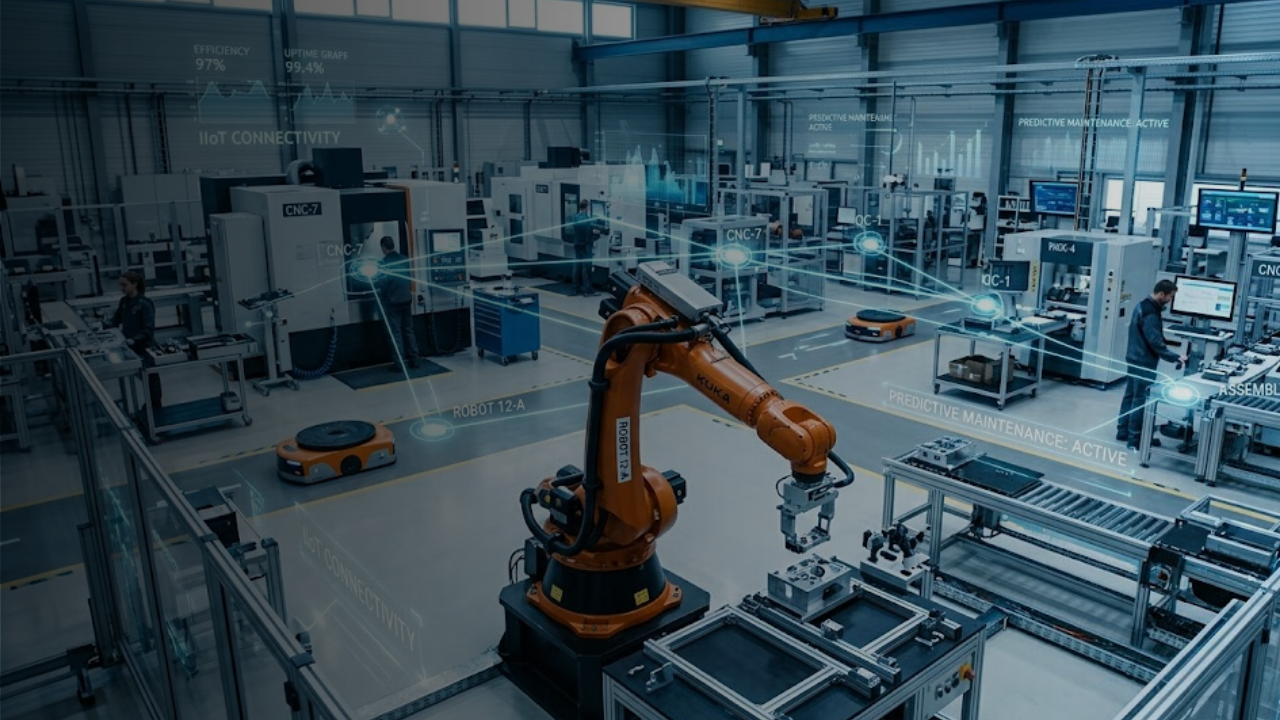
The reality is that smart manufacturing is no longer a futuristic concept, it is a competitive necessity. At the heart of this shift lies the Industrial Internet of Things (IIoT). By moving beyond the hype, we can look at IIoT for what it truly is: a practical infrastructure that turns the shop floor into a source of intelligence.
Here is the blueprint for building a connected, data-driven production environment.
What is IIoT, Really?
At its core, industrial IoT is the network of sensors, instruments, and other devices networked together with industrial applications, including manufacturing and energy management.
In a traditional factory, machines operate in silos. They produce data, but that data is often lost or trapped within the PLC (Programmable Logic Controller) or the machine’s local interface. IIoT changes the architecture. It connects these “dumb” devices to a unified network, allowing for seamless data flow from the shop floor to the cloud, and ultimately, to your decision-makers.
The Practical Roadmap to Smart Manufacturing
Implementing IIoT is not about ripping out legacy equipment and replacing it with brand-new, expensive hardware. It is about connectivity and visibility. Here is how to execute a phased transition.
Phase 1: Audit and Shop-Floor Connectivity
Before you can analyze, you must connect. Start with an audit of your existing assets. Which machines are the bottlenecks? Which assets are critical to your throughput?
- Retrofitting: You don’t need new machines to get smart data. Retrofit older equipment with external sensors (vibration, temperature, current, and pressure) to extract data points that were previously invisible.
- Standardization: Ensure your protocols are standardized (e.g., using OPC-UA or MQTT) so that different machines can “speak” the same language.
Phase 2: Centralized Data Collection
Once you have connectivity, you need a destination for that data. This is where you implement an Edge or Cloud gateway. The goal here is to create a “Single Source of Truth.” If your shop floor data is scattered across five different Excel spreadsheets and three legacy databases, it is useless for real-time decision-making. Consolidating this data into a centralized platform is the true foundation of factory automation.
Phase 3: Activating Manufacturing Analytics
Raw data is just noise. The transition to smart manufacturing happens when you apply manufacturing analytics. By using dashboards that track Key Performance Indicators (KPIs) like Overall Equipment Effectiveness (OEE) in real-time, you move from reactive to proactive.
- Predictive Maintenance: Instead of fixing machines when they break, your data tells you when they are about to break, reducing unplanned downtime.
- Bottleneck Analysis: See exactly where material flow slows down, allowing you to rebalance your line for maximum throughput.
Driving Operational Agility
The ultimate ROI of an IIoT implementation is operational agility. When management has a real-time window into production, they can make decisions in minutes that used to take days of report compilation.
If a raw material delay occurs, or a high-priority order comes in, an IIoT-enabled factory allows you to adjust production schedules dynamically. This level of transparency creates an environment where efficiency isn’t just a quarterly goal, it’s a daily, automated reality.
Overcoming the Implementation Hurdles
While the benefits are clear, the path is rarely smooth. Two major obstacles often stand in the way of successful digital transformation:
- Cybersecurity: Connecting your shop floor to the internet creates new vulnerabilities. Ensure that your IIoT architecture includes end-to-end encryption, network segmentation, and robust access controls.
- Cultural Resistance: Adoption fails when the workforce feels threatened by automation. Frame IIoT as a tool to empower workers, by removing the “grunt work” of data collection and manual tracking, you allow your team to focus on high-value problem solving and innovation.
Conclusion
The IIoT blueprint is not about the technology itself; it is about the actionability of the information the technology provides. By focusing on shop-floor connectivity, centralized data management, and insightful analytics, you can transform your facility into a lean, agile, and competitive powerhouse.
Don’t wait for the perfect moment to start. Identify your biggest pain point, connect the machines responsible for it, and start letting the data show you the way forward.

We serve the marine transportation, oil & gas, power generation, oleochemicals and petrochemical industries.
Join Our Newsletter
Stay updated with the latest in our field! Subscribe to our newsletter and visit our website for more information.