Industry 4.0: Transforming Manufacturing Through Smart Automation
Manufacturing is in the middle of its biggest shift since the assembly line. Industry 4.0 is no longer a buzzword reserved for tech conferences, it’s the operating reality for factories that want to stay competitive. By combining smart manufacturing principles with connected devices and intelligent software, companies are rethinking how products get made, monitored, and improved.
This shift isn’t about replacing people with machines. It’s about giving manufacturers real-time visibility, predictive insight, and the flexibility to respond to change faster than ever before.
What Is Industry 4.0?
Industry 4.0 refers to the fourth industrial revolution: the fusion of physical production systems with digital technology. Where previous industrial revolutions introduced steam power, electricity, and basic automation, this one is defined by connectivity and data.
At its core, Industry 4.0 relies on a network of interconnected systems that “talk” to each other and to human operators. Machines collect data, software analyzes it, and decisions sometimes made by people, sometimes by algorithms happen faster and with more precision than traditional methods allow.
The Role of Industrial IoT
Industrial IoT (IIoT) is the backbone of this transformation. Sensors embedded in equipment continuously capture data on temperature, vibration, pressure, output rates, and dozens of other variables. That data flows into centralized platforms where it becomes actionable.
A few ways IIoT is reshaping factory floors:
- Predictive maintenance – Sensors detect early signs of equipment wear, allowing teams to repair machines before they fail, reducing costly downtime.
- Real-time monitoring – Managers can track production line performance from a dashboard instead of walking the floor.
- Supply chain visibility – Connected devices track inventory and shipments, reducing bottlenecks and stockouts.
- Energy optimization – Smart sensors identify where energy is wasted, helping plants cut costs and meet sustainability targets.
This constant flow of information turns factories into responsive, data-driven environments rather than static production lines.
Automation Technology Driving the Change
Automation technology has existed in manufacturing for decades, but Industry 4.0 takes it further. Today’s automated systems aren’t just mechanical, they’re intelligent.
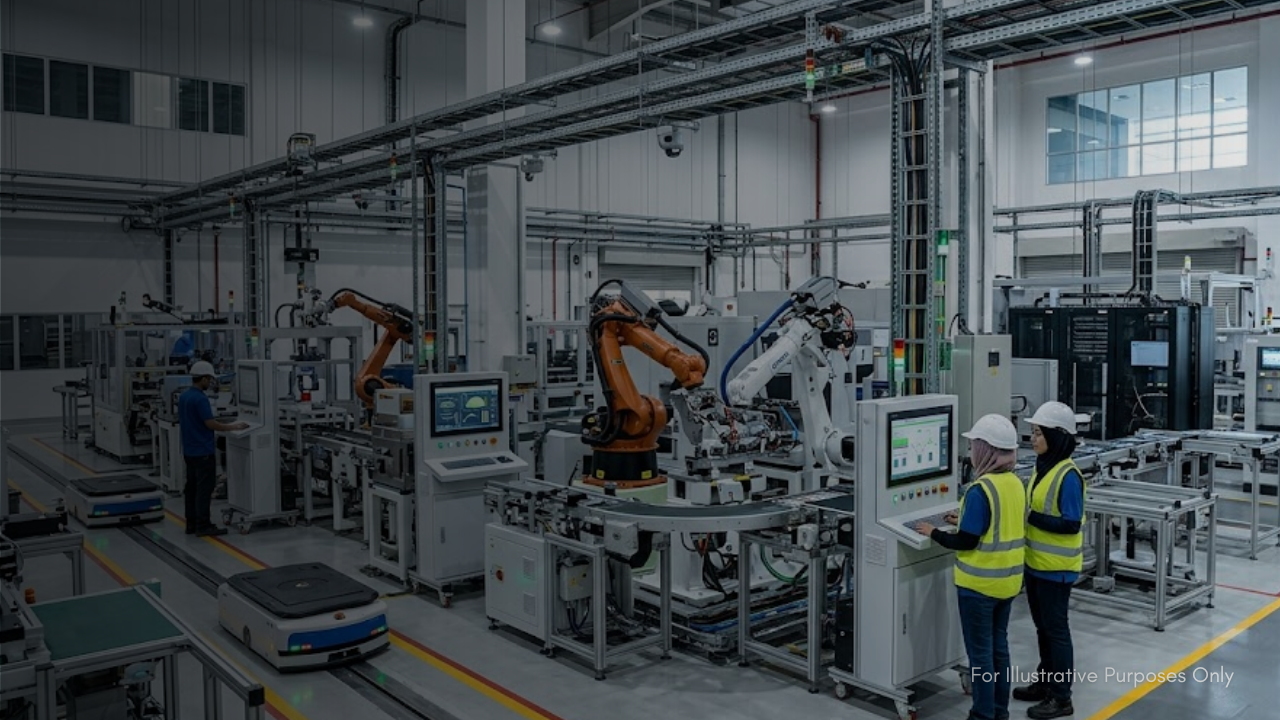
Robotic arms now adjust their movements based on real-time sensor feedback. Machine learning models predict quality issues before a defective product ever reaches the end of the line. Automated guided vehicles (AGVs) navigate warehouses without fixed tracks, rerouting dynamically around obstacles.
This level of automation reduces human error, speeds up repetitive tasks, and frees skilled workers to focus on oversight, problem-solving, and innovation rather than manual labor. It’s a shift from automation that simply replaces tasks to automation that enhances decision-making.
Smart Manufacturing in Practice
Smart manufacturing brings these pieces together into a cohesive system. Picture a factory where:
- Sensors feed live data into a central platform.
- Software analyzes that data to spot inefficiencies or risks.
- Automated systems adjust production parameters instantly.
- Human teams receive insights to make strategic decisions.
This loop sense, analyze, act, learn is what separates a smart factory from a traditional one. It allows manufacturers to customize products at scale, reduce waste, and respond to market demand without overhauling entire production lines.
Industries from automotive to pharmaceuticals are already seeing results. Car manufacturers use smart systems to manage just-in-time parts delivery. Food and beverage companies use sensor data to maintain consistent quality across batches. Electronics manufacturers use automated quality checks to catch defects in microseconds.
Why Manufacturers Can't Afford to Wait
Adopting Industry 4.0 isn’t just about efficiency gains, it’s about survival in a market where customer expectations and global competition keep rising. Companies that delay risk falling behind competitors who can produce faster, with fewer errors, and at lower cost.
The good news is that adoption doesn’t have to happen all at once. Many manufacturers start small: installing IoT sensors on a single production line, piloting predictive maintenance on critical machinery, or integrating one automated process before scaling further. This incremental approach reduces risk while building internal expertise.
Looking Ahead
Industry 4.0 represents more than new equipment, it’s a fundamental shift in how manufacturing decisions get made. As Industrial IoT networks expand and automation technology becomes more sophisticated, the factories that thrive will be the ones that treat data as a strategic asset, not just an operational byproduct.
For manufacturers ready to modernize, the path forward is clear: invest in connected systems, build a culture that values data-driven decisions, and treat automation as a partner to human expertise rather than a replacement for it. Those who embrace this transformation now will be the ones setting the pace for the industry’s next chapter.

We serve the marine transportation, oil & gas, power generation, oleochemicals and petrochemical industries.
Join Our Newsletter
Stay updated with the latest in our field! Subscribe to our newsletter and visit our website for more information.